

Opening reception: Saturday, March 14, 2026, from 3 to 5 p.m.
Nicholas Crombach: Xenolithic
Xen·o·lith /ˈzenəˌliTH/ noun Geol.
A piece of rock trapped in another type of rock.
– National Geographic Education
Text by Jeffrey Nye, Curator: Latcham Art Centre (2025)
Our ecological footprints are everywhere. So much so that in 2000, scientists Eugene Stormer and Paul Crutzen coined the term Anthropocene which defines our current age by the lasting impact of human activity on Earth’s geology, climate, and ecosystems . With that in mind, Nicholas Crombach’s Xenolithic explores how materials accumulate, persist, and transform—both as artifacts of the past and as evolving elements within our changing landscape. By amassing a wide array of collected materials, both naturally derived and human-made, Cronbach’s sculptures invite viewers to consider how our complex relationship with “stuff” has impacted the intertwined courses of human history and natural history.
The incorporation of found objects into artwork has played a significant role in the history of art. In the early 1900s, artists such as Pablo Picasso used collage to incorporate scraps of newspaper, wood, and other materials into their paintings, drawings, and sculptures. This new development raised the question, “If any commonplace thing can become art, then where is the line between an art object and any other object?” This idea would be pushed to its limit by the Dadaists, a collection of artists who were interested in destabilizing traditional artistic and social values as a reaction to the horrors of World War I. Dadaist artworks such as Marcel Duchamp’s Bicycle Wheel—a wheel mounted on a wooden stool—were known as objets trouvés (found objects) or readymades and featured minimal intervention by the artists. What makes this art-historical context particularly compelling in relation to Crombach’s work is how it underscores the diverse ways that we seek to order and categorize the material world—whether by determining what is or isn’t art or by assigning objects to specific scientific or archaeological classifications.
The way that Crombach combs through his environment, searching for objects that provide an unanticipated spark of his imagination also echoes pop artist, Andy Warhol’s famous love for collecting. Warhol would scavenge art galleries, thrift stores, and flea markets—collecting with no distinction between the objects that interested him. A newspaper scrap could be as valuable to Warhol as an original artwork. Warehouses are full of boxes containing seemingly random groupings of the things that Warhol amassed—time capsules that are now being meticulously opened and documented by curators at the Andy Warhol Museum . Crombach’s approach to collecting, conversely, is distinguished by his interest in the recontextualization and display of the objects that he acquires.
The possessions, treasures and belongings that make up personal collections have emotional, financial, and social value. Some of that value is sentimental, a magical connection that we project onto an object that symbolically links us to a place, experience or person. An object’s status can shift from something that is basic and utilitarian to a collector’s item that accumulates worth because of its rarity, age, condition, or its connection to a person or event that has perceived importance. If those connections are severed, however, whether through the long passage of time, or the loss of stories and memories, any object can also fall into the category of castoff or waste.
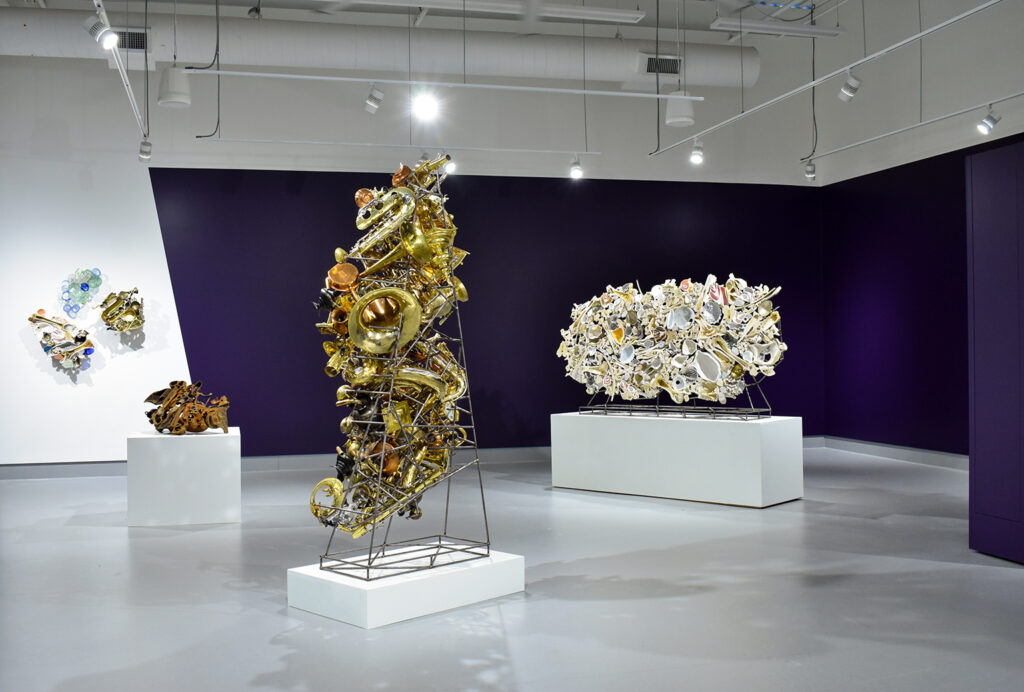
Many of the objects within Crombach’s work are scavenged from farmyards, thrift shops, and garage sales. Among other things, these objects include brass instruments, conch shells, bones, rocks, ceramics, and household items. Their meanings, associations and provenance are unknown. The new context of these displaced belongings—carefully grouped by colour, texture, and material relationships and embedded within larger artworks—opens the door to wonder and speculation about their histories. There is an invitation in these works to find something familiar and relatable, such as a piece of glassware reminiscent of something once owned by a grandparent. More imaginative or poetic connections between objects can therefore be made by viewers, as opposed to the linear narratives of museological categorization.
To further the dialogue with museum practices, Crombach’s artwork incorporates elements of gemmological or archaeological display. The various rock fragments in xenoliths are typically revealed by cross-section in the galleries of natural history museums. This method of display informed Crombach’s Xenolith series. In these works, the cross-cut objects are embedded in molten aluminium, which mirrors the geological processes the series is named after. Each object in Xenolithic has been skillfully cut into cross sections by the artist to reveal surprising and uncanny glimpses into their hidden interiors. The range of steel structures that support Crombach’s Cross Section sculptures are imaginative reinterpretations of the armatures that support museum artifacts such as dinosaur skeletons or suits of armour. Sometimes architectural, sometimes whimsical, Crombach’s structures provide a floating effect for the clusters of objects that they support.
Crombach’s work reactivates ideas about what art can tell us about our relationship to the material world. As more of our “stuff” enters the environment, the distinction between humanity and nature becomes more confused. Natural environments are overwhelmed by industrial activity and by the garbage and waste that we produce. Ironically, nature is the source from which all that stuff is derived, even plastic is created from naturally occurring gas and oil deposits. So, where then is the line between natural things and human things? Why aren’t the practices and processes of production undertaken by humans (naturally occurring beings, after all) considered “natural”? Perhaps, if we reconsider this imaginary line and begin to think of the interconnectedness of our actions and how they impact the world around us, we can come to a different understanding of our place and role on this planet.
About the Artist
Nicholas Crombach is an artist based in Kingston, Ontario. His practice engages the aesthetic frameworks of natural history collections, museological display, and the motifs of historical fine and decorative arts. He disrupts these established conventions through a use of unexpected materials, details, and gestures to create contemporary confrontations. Grounded in a sustained inquiry into materiality and process, Crombach’s work constructs visual dialogues that recontextualize the familiar, interrogate systems of perception, and foreground the entangled relationship between nature and culture.
Nicholas Crombach