Opening reception: Saturday, September 12, from 3:00 p.m. to 5:00 p.m.
Jessica Houston : Water, Water, Everywhere | Nor Any Drop to Drink
Shades of Saturation // A Prismatic Antarctica
Text by Isabelle Gapp
Ice crystals form, freeze, melt, and dissolve; open water courses past the floe edge; icebergs drift along the horizon, their hazy underbellies buried deep in the waves; and new snowflakes are caught up in the frenzy of a blizzard. Water moves and transforms; its materiality cannot be fixed in place. For Jessica Houston, the material realities of Antarctica’s waters saturate the film, photographic prints and monochromatic paintings that make up Water, Water Everywhere. By focusing on the permeability of water, Houston destabilises long-held notions of Antarctica as a place that is pristine, fixed and available to imperial visions of conquest and extraction.
Throughout Water, Water Everywhere, colour saturates the senses. Melody Jue and Rafico Ruiz write of “saturation,” where multiple phenomena and senses occur and confound simultaneously. Houston’s Antarctica is similarly saturated: ice crystals melt on a macro lense, casting prisms of light. A prismatic Antarctica. Snowflakes are in themselves prisms, crystal facets that grow and melt together. As if viewed through a microscope, the fractal lines of the snowflake are further captured in isolated paintings; blue, yellow, white, crimson pink and red.
Colour is at once symbolic and material. A glowing, sun-like yellow rises over a digital photograph of a cluster of icebergs; this same colour is almost necrotic when transposed over footage of historic whaling. Elsewhere, a crimson red, made of microplastics, submerges mythical creatures; this is “Coleridge’s ominous crimson sea,” as Houston describes. Water, pollution and plastic seep into one another. Pigments made from plastic and liquid waste—PFAS, polystyrene, carbon, Styrofoam, microplastics—are also presented in Victorian-style glass apothecary jars. Now contained, these same colours stain fabric stretched around oversize, geometric wooden frames. These colours are seductive, but their material origins are not innocent. Colour and materiality collapse distances between places and times, connecting the apparently pristine waters of Antarctica to the human-made pollutants that circulate through them.
Elsewhere, fissures, cracks and lines mark the icy surface like scratches on a glass plate. As snowflakes take shape in a series of gelatin silver prints, they not only hark back to earlier nineteenth-century photographic practices, but they also return us to the material processes of image-making itself. Imperfections in the image make the snowflakes appear almost microscopic; other microorganisms dance across this frozen realm. The materiality of the print carries with it the memory of water, through the liquid, chemical emulsion central to its process.
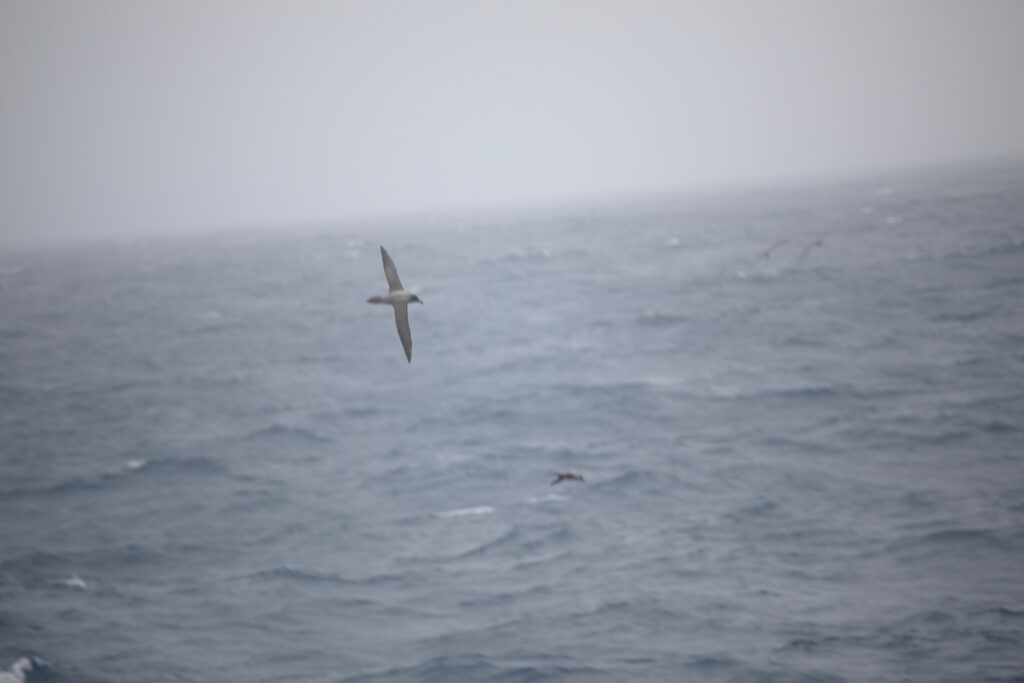
Throughout, Houston embraces imperfection. Where lines and blemishes mark the gelatin silver print of an albatross, in a digital print the soaring albatross is juxtaposed by the diagonal of the slanted horizon. A crooked view over an open sea. These distortions or “glitches,” as Houston describes them, alter our perception of the frozen continent. Rather than simply reproducing the visual conventions through which Antarctica has historically been made knowable, Houston unsettles them. We have largely constructed a singular narrative of the polar worlds, one of vast, never-ending whiteness, where “aesthetic awe and moral transcendence” are projected onto the landscape. Houston’s Antarctica is instead imperfect, saturated and materially entangled: its ice becomes water, its colours become pollutants, and its images refuse to remain fixed.