Opening reception: Saturday, September 12, from 3:00 p.m. to 5:00 p.m.
Brigitte Radecki : It Was a Dark and Stormy Night
Text by Laurie Milner
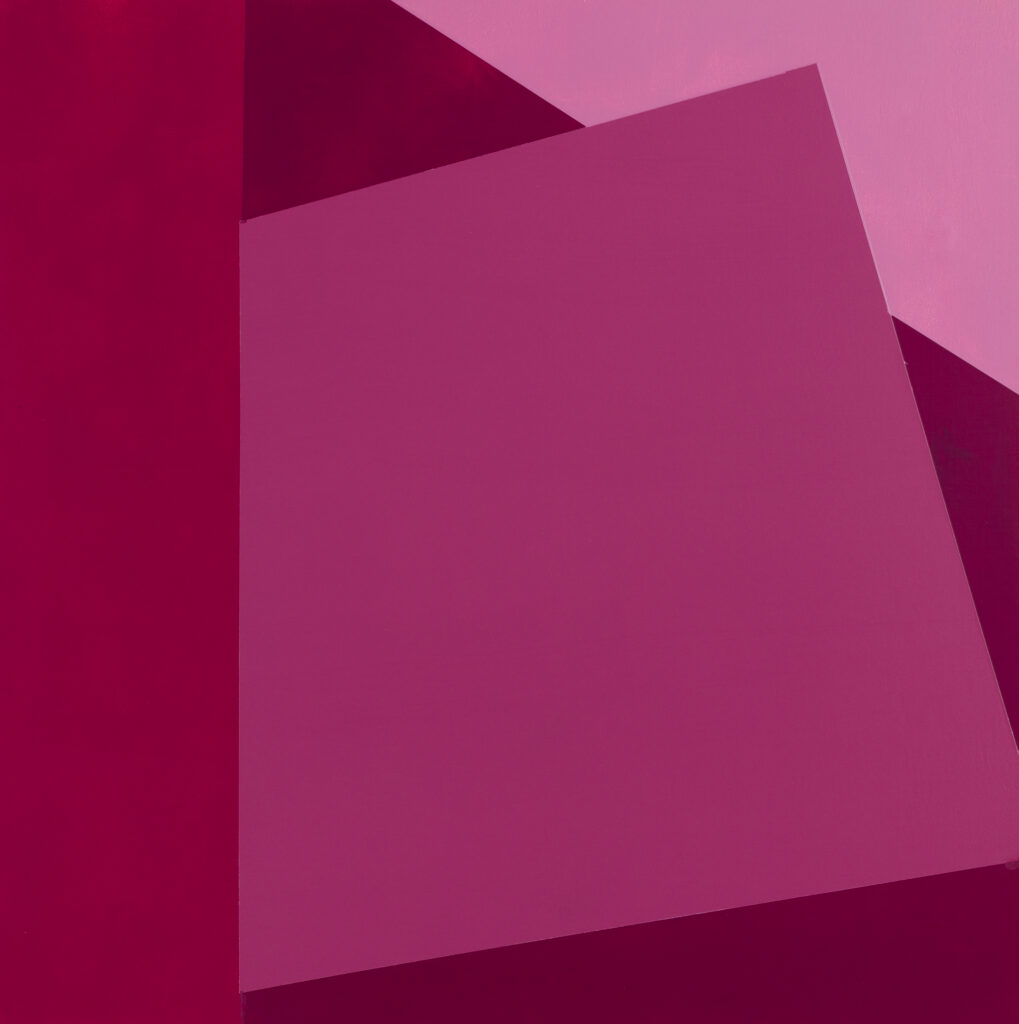
There is something both alluring and ominous about Brigitte Radecki’s latest group of paintings. On each square support, flat, luminous panes of a singular hue—red, green, yellow, blue—appear to float over, slide under, and butt against one another with varying degrees of force. The forms are clearly defined, but their spatial relations are uncertain: will they hold, or shift in the next instant? This sense of potential, of aliveness, is heightened by the optical interactions of carefully calibrated saturations and values. I find myself experiencing something like landscape: the shifting effects of light and atmosphere on perception.
There is no “outside” to the forms on the painting, no background to the foreground, and no illusion of separation between image and me. The paint surfaces are almost smooth; if I look at them from just the right angle, with the light raking across the surface, I see the rigour of Radecki’s paint handling as well as the subtle irregularities that come from making with a human hand. I feel close to the paintings, perhaps too close. I instinctively step away.
There is a compelling paradox at the heart of Radecki’s approach. She establishes precise conditions for chance and then relinquishes control over what those conditions produce. She haphazardly folds a sheet of construction paper, drops it on the floor, photographs the resulting form, and uploads the digitally transformed image to her computer. She then translates this accidental configuration through an extended process of looking, mixing, adjusting, and painting, layer by layer, in thin washes of pigment. The quick, offhand event that begins the process becomes something slow, drawn out, meditative, and precise: a patiently executed painting whose final appearance could not have been predicted from the process that produced it.
Even before reading the titles—Burning 25, Sliding Soil, The Sky is Falling, It Was a Dark and Stormy Night, Greenhouse, and Aftermath—I sensed a portentousness in the works. The titles allude to events: fire, moving earth, a storm, heat trapped in an atmosphere, and what remains after something has happened. They connect me to the world in which I live, and to the uncertainty that increasingly pervades it. In the context of our changing climate, this uncertainty feels particularly charged.
The old sublime placed us before the overwhelming power of nature: the mountain, the ocean, the storm. These paintings lead me somewhere else. Their power does not come from grandeur but from uncertainty—from a world in which events unfold through systems too complex to see in their entirety, and whose consequences cannot be fully predicted. We are not simply spectators standing outside these systems; we are implicated in them, even as we struggle to comprehend their effects.
Radecki’s paintings ask me to remain in the space between knowing and not knowing, between accident and intention, between beauty and apprehension, between event and aftermath.
Could this be what the contemporary sublime feels like?